
A Reference Guide to Closing Costs, Seller Credits, and Construction Soft Costs
When you buy real estate, the closing statement lists 30 or more line items. Some get added to your depreciable basis. Some get expensed in the year you close. Some get amortized over the loan term. And some don't change your tax position at all.
The same question shows up again on construction and major renovation projects. Architect fees, GC markups, construction loan interest, permits — what gets capitalized into basis, and what comes off the top as a current deduction?
This post is a reference guide. It's organized by category, with the default treatment, the governing authority, and the most common mistake for each item. Use it as a desk reference when you're working through a closing statement or a development budget.
The core rules to keep in mind:
- IRC §1012 and Reg. §1.1012-1 — basis is generally your cost, including assumed liabilities.
- Reg. §1.263(a)-2 — costs that are "inherently facilitative" of acquiring real property must be capitalized. That means any cost you had to pay to make the deal happen. If you wouldn't have bought the property without paying it, it gets added to basis instead of being deducted right away. Title insurance, attorney fees, transfer taxes, recording fees, surveys, broker commissions — all facilitative, all go into basis.
- IRC §263A — direct and allocable indirect costs of producing property must be capitalized into the produced asset.
- IRS Pub 551 — the practical list of which settlement costs go into basis and which are loan costs.
A quick glossary of the code sections you'll see below:
- IRC §1012 — basis is your cost
- IRC §61 — gross income
- IRC §163 — interest deduction rules
- IRC §164(d) — allocation of property taxes between buyer and seller
- IRC §165 — deductible losses
- IRC §195 — start-up expenditures
- IRC §263A — UNICAP, capitalization of production costs
- IRC §266 — election to capitalize carrying costs
- IRC §280B — demolition costs
- Reg. §1.263(a)-2 — acquisition costs of real property
- Reg. §1.263(a)-5 — costs of acquiring an entity
- Reg. §1.1012-1 — cost basis mechanics
- IRS Pub 551 — settlement costs into basis vs. loan costs
- IRS Pub 946 — how to depreciate property
Buyer-Side Closing Costs: What Goes Into Basis
These items get capitalized as part of your acquisition cost and are depreciated along with the property (allocated between land and building based on relative fair market value).
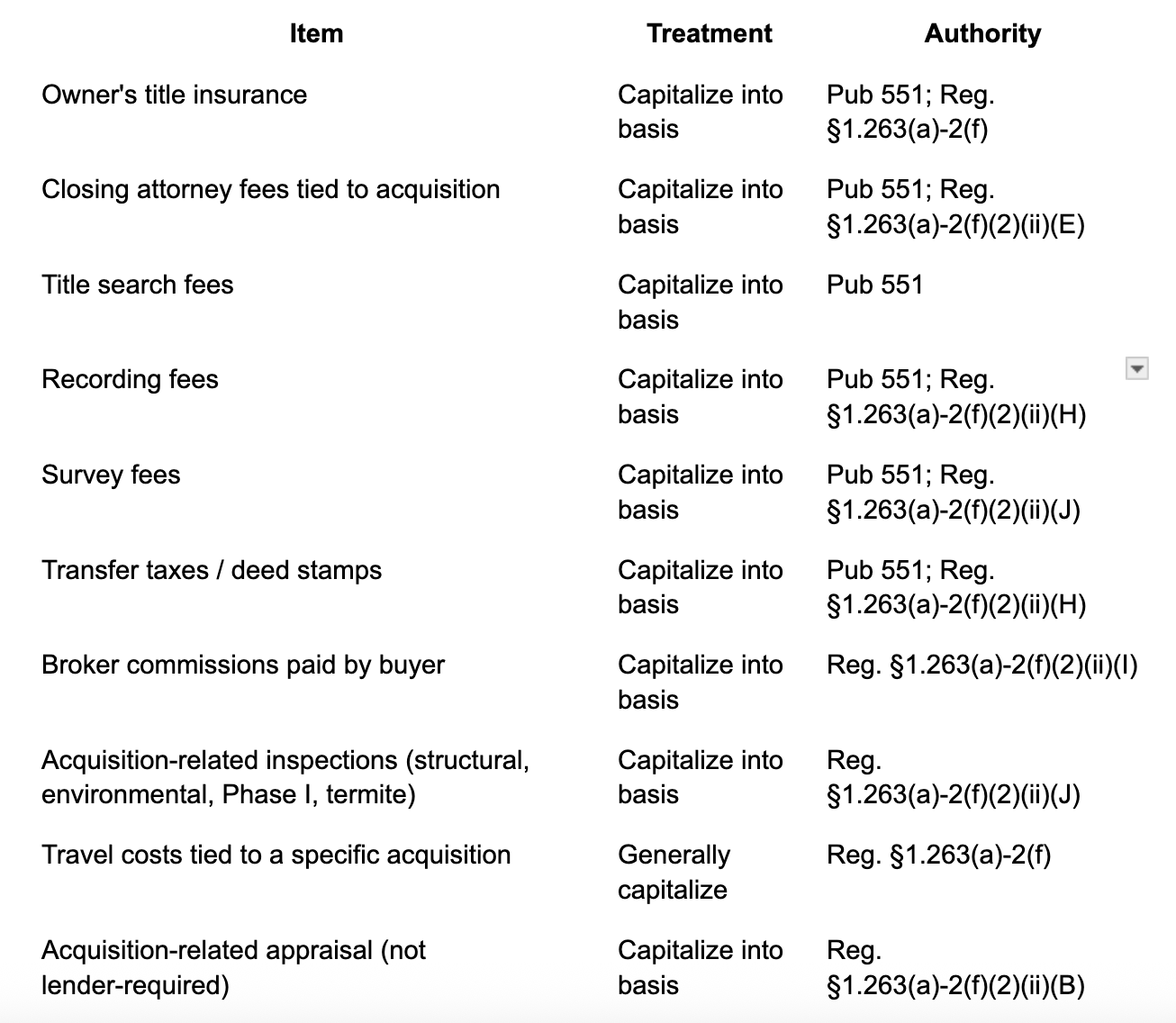
Most common mistake: Expensing title insurance, transfer taxes, or recording fees as period costs. The regulations are explicit that these are facilitative acquisition costs.
Buyer-Side Closing Costs: What Does NOT Go Into Basis
These items are connected to the loan rather than the property itself. They're either amortized over the loan term, deducted currently, or just don't move basis at all.
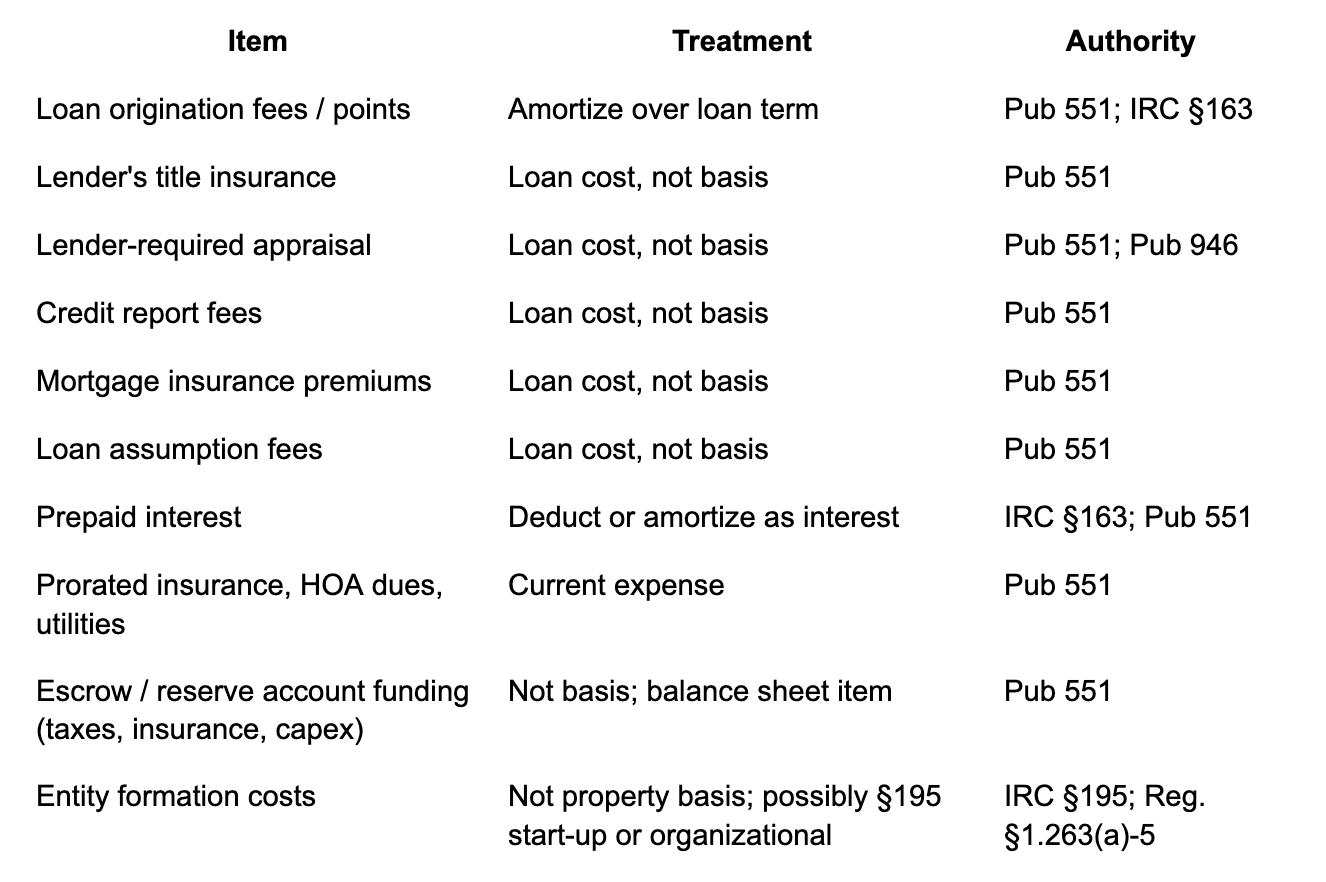
Most common mistake: Lumping all closing-statement charges into the building basis. Loan costs follow a separate regime and don't increase the depreciable basis of the property.
Seller Credits, Prorations, and Assumed Liabilities
This is the area that causes the most confusion on real deals. The general principle: credits and prorations adjust the net economic terms of the deal, but they're not income to the buyer and they don't go into basis as separate line items.
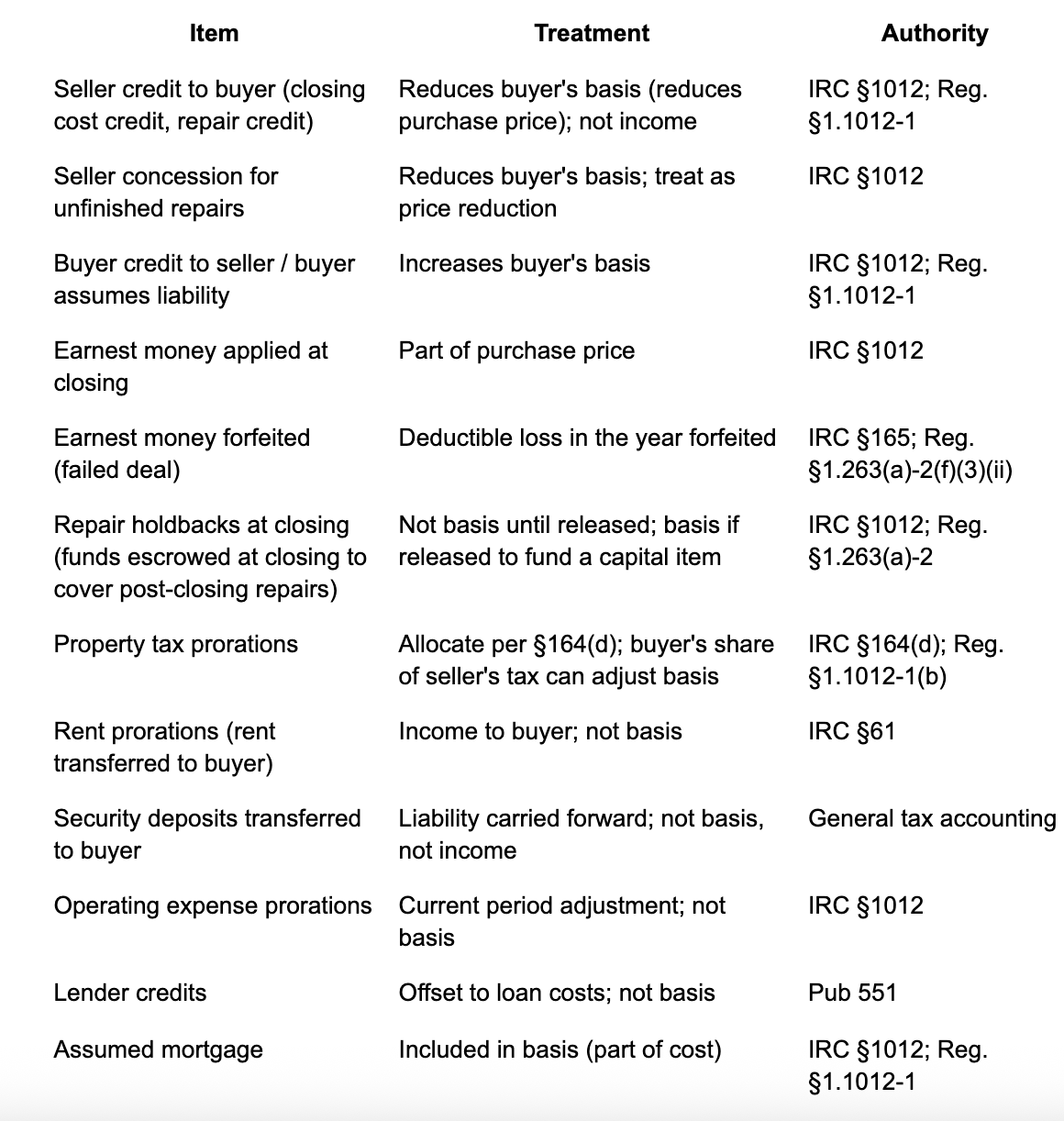
Most common mistake: Treating a seller credit as taxable income, or failing to reduce the buyer's basis when a credit is given. A $50,000 repair credit doesn't put $50,000 in the buyer's pocket — it lowers the purchase price by $50,000, which lowers the depreciable basis going forward.
Allocating Basis Between Land and Building
Land doesn't depreciate. Building does (27.5 years for residential, 39 years for nonresidential). So how you split the purchase price between the two directly drives every depreciation deduction you'll claim.
The IRS accepts allocation based on relative fair market value. The hierarchy of support, strongest to weakest:
- Appraisal allocation — the strongest position, especially when commissioned at acquisition.
- Purchase price allocation in the PSA — useful when buyer and seller are adverse parties.
- Tax assessor ratio — acceptable as a backup, particularly when other support is weak. Directionally helpful in waterfront or high-demand markets but can skew the result.
- Replacement cost or comparable sales analysis — used when the first three aren't available.
Capitalized closing costs aren't a separate line item — they get rolled into the basis of the property itself, then split between land and building in the same proportion as the purchase price. The building portion goes into depreciable basis. If a cost is clearly tied to land only or building only, it goes there directly instead of being prorated.
Most common mistake: Defaulting to the assessor ratio without checking whether it produces a reasonable result. An over-allocated land number means lower depreciable basis and a smaller cost seg study.
Construction and Major Renovation: Soft Costs
For ground-up development and substantial renovation, the default rule is capitalization under IRC §263A which is also known as the UNICAP (uniform capitalization) rules.
The idea is when you produce or improve property, you can't write off the costs in year one. You have to add them to basis and recover them through depreciation over time. §263A goes a step further than the general capitalization rules by also pulling in indirect costs — overhead, project management, financing costs during construction — that are allocable to the production effort. Most "soft costs" land in this bucket.
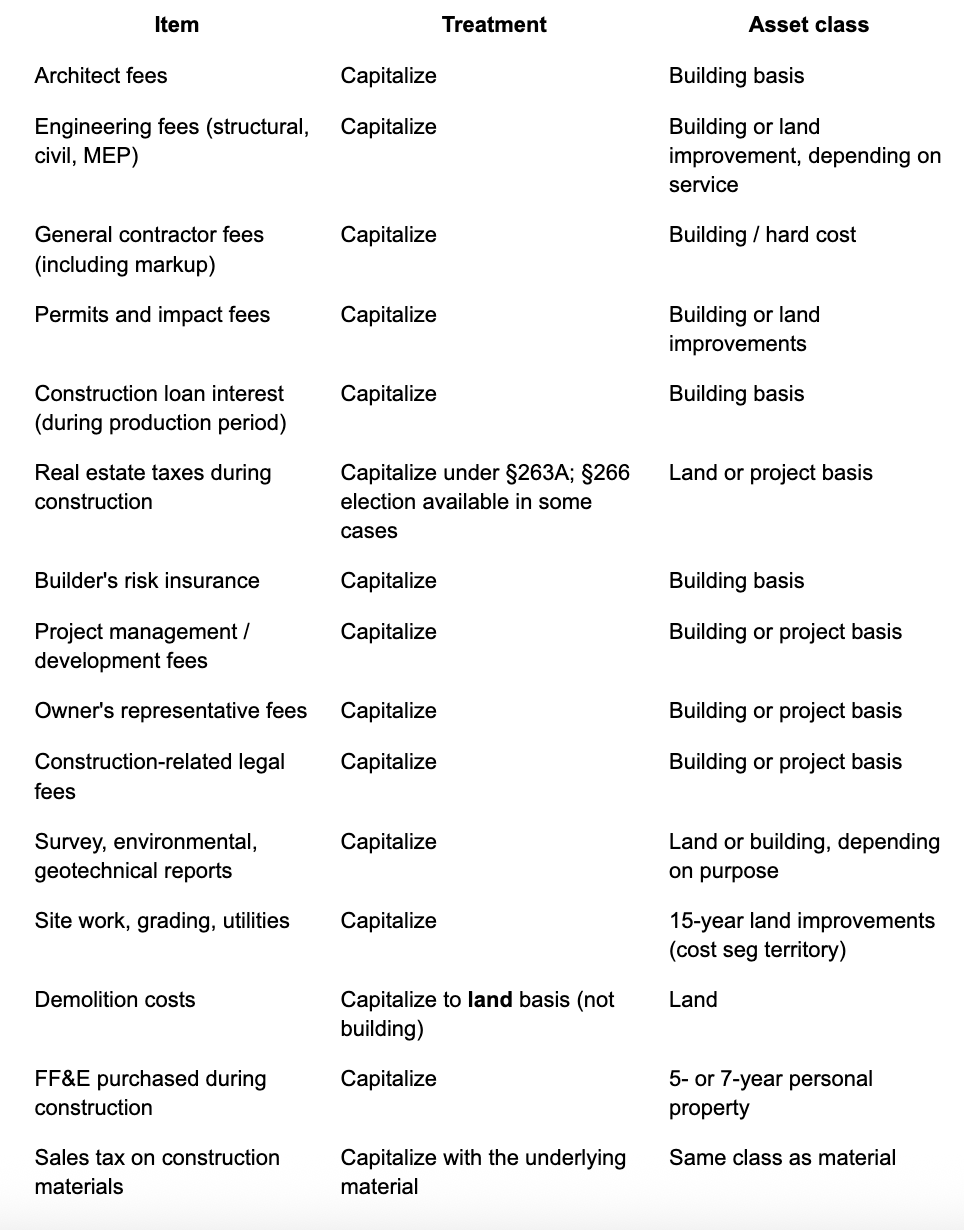
Most common mistakes:
- Expensing architect, engineering, or GC fees as professional services. §263A requires capitalization.
- Adding demolition costs to building basis. §280B (demolition costs) sends them to land.
- Deducting construction loan interest during the production period. §263A(f) requires capitalization.
- Defaulting all Furniture, Fixtures & Equipment (FF&E) into the 39-year building bucket. FF&E is 5-year personal property. These are the items inside (and around) a property that isn't structurally part of the building. Examples include appliances (fridge, stove, dishwasher), ceiling fans, vanity lights, blinds, carpeting, security cameras, lobby furniture, restaurant equipment.
Why This Matters for Cost Segregation
A cost seg study starts with the depreciable basis you provide. The more accurate that basis is with closing costs properly capitalized, seller credits properly tracked, and soft costs properly allocated, the better the study can do its job. Two areas are worth paying attention to upfront:
The two specific places this comes up most often:
- Closing-cost capitalization. Title insurance, transfer taxes, recording fees, broker commissions, and acquisition-related legal fees all belong in basis. Investors who expense these are understating their depreciable basis.
- Soft cost allocation in construction. Architect and engineering fees, construction loan interest, permits, and project management fees should be allocated proportionally across the hard-cost asset classes the study identifies — not dumped entirely into the 39-year (or 27.5-year) building bucket. Done correctly, soft costs accelerate alongside the hard costs they support.
When in doubt, the order of authority is IRC, Treasury Regulations, IRS Publications, then practitioner guidance. Pub 551 and Reg. §1.263(a)-2 cover most of the closing-statement questions. §263A and the regulations beneath it cover most of the construction questions.
If you're working through a closing statement or a development budget and want a second set of eyes before the basis is locked in, reach out to the Maven team — getting this right at the front end is what makes the cost seg study work.