
If you own apartments or short-term rentals and you've started looking at mobile home parks, the first walkthrough can be confusing.
You're used to underwriting buildings. Kitchens, bathrooms, roofs, HVAC. At a park, you drive in and see gravel, utility pedestals, a few street signs, and rows of homes that mostly belong to your tenants.
The instinct is that there's not much there to depreciate, but a mobile home park is one of the most tax-advantaged assets in real estate, and it’s because almost none of your money is sitting in a building.
Why Investors Are Buying Mobile Home Parks
Before the tax piece, it's worth understanding why this asset class has pulled in so much capital over the last decade.
- Demand is deep and supply is frozen. Parks are one of the last sources of unsubsidized affordable housing in the country, and almost no new ones are being built. Zoning makes sure of it. You're buying into a shrinking supply of something people need.
- Your tenants usually own the homes. In a typical park, you own the land and the infrastructure and you rent out the pad. The tenant owns the structure they live in. That means you're not replacing water heaters, repainting units, or turning apartments. Capital expenditures per unit run a fraction of what they do in multifamily.
- Turnover is unusually low. Moving a mobile home costs thousands of dollars and often isn't physically possible with an older unit. Tenants stay. That stickiness shows up in your occupancy and in your leasing costs.
- The ownership base is still fragmented. A large share of parks are owned by people who bought them decades ago and have never raised rents to market or submetered the utilities. Operational upside is still available in a way it isn't in stabilized apartments.
And the big piece that matters for taxes is that in a park, your capital sits in infrastructure, not in interiors.
How Cost Segregation Works on a Mobile Home Park?
Most investors know the basic rule. You depreciate a building over 27.5 years if it's residential, 39 if it's commercial. But you don't have to run the whole purchase price through that one schedule.
When you buy a property, you're really buying a collection of separate components, and the tax code assigns different lives to different components. The structure itself is stuck on the long schedule. But site infrastructure is generally treated as land improvements on a 15-year schedule, and certain equipment can be classified as shorter.
Cost segregation is simply the process of identifying those components and putting each one on the schedule it actually belongs on.
In an apartment building, those shorter-life components are a small share of the purchase price. You're mostly buying the building itself, and the building sits on the long schedule.
In a park, that ratio flips. You're mostly buying the pads, the roads, and the utility systems running beneath them.
Mobile Home Park Depreciation Life by Component
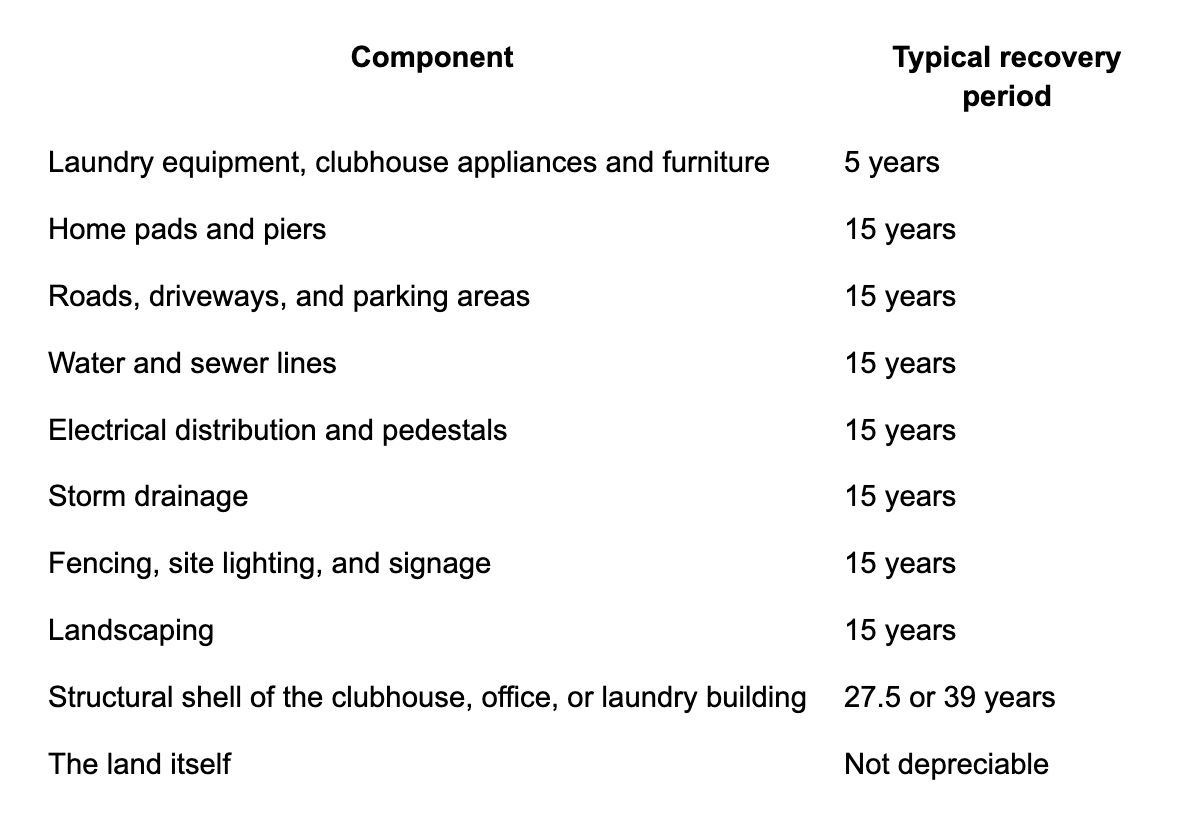
Across the industry, cost segregation studies on mobile home parks commonly reclassify somewhere in the range of 30% to 50% of the depreciable basis into shorter-life categories. For a typical apartment building, that figure is closer to 20% to 35%.
Mobile Home Park Cost Segregation Example
Take a park that sells for $3.5 million.
You allocate 20% to land, which isn't depreciable. That leaves a depreciable basis of $2.8 million.
Without a cost segregation study, you'd put the whole $2.8 million on a 27.5 year schedule and deduct roughly $102,000 in year one.
With a study that reclassifies 40% of the basis, about $1.12 million moves into 5- and 15-year categories. With 100% bonus depreciation, all of it is deductible immediately. Add the normal depreciation on what's left and your first-year deduction is roughly $1.18 million.
That's about $1.08 million in additional deductions in year one. For an investor in the 37% bracket, that's roughly $400,000 in taxes deferred, sitting in your account instead of the Treasury's.
Now run the same numbers on an apartment building with an identical $2.8 million basis. At a 25% reclassification, your first-year deduction lands around $776,000 rather than $1.18 million. Same purchase price, same study cost, roughly $150,000 less in first-year tax savings.
That gap is what make mobile home parks such a great asset class.
(These figures are simplified and use industry-typical ranges to illustrate the mechanics. Your park's allocation depends on its actual components.)
3 Factors That Determine Your Cost Segregation Results
Here's where I'd push back on some of what you'll read about this asset class.
You'll see confident percentages quoted before anyone has looked at your property. Treat that as a warning sign. Three things determine what a park study actually produces.
- Who owns the utilities. In plenty of parks, the city or the utility company owns and maintains the water, sewer, or electrical systems running through the property. If you don't hold the depreciable interest in that infrastructure, you can't depreciate it, regardless of what a percentage-based estimate assumed.
- Whether the site work is documented. Grading and excavation tied to your pads and utility runs can be depreciated. General site preparation that stays useful no matter what you build on top of it is part of your land basis, and land doesn't depreciate. A study that buries all of it in one line item called "site work" is creating a problem for you, not solving one.
- Whether the study is engineering-based. The IRS has been explicit that rule-of-thumb percentage allocations are the weakest position a taxpayer can take. Engineering-based studies that tie to actual costs and components are what hold up.
Is Cost Segregation Worth It for a Mobile Home Park?
Accelerated depreciation is a timing benefit, not free money.
When you sell, some of what you accelerated comes back as recapture, and the components reclassified as personal property are taxed as ordinary income rather than at capital gains rates.
For most investors it still makes sense as the money you keep today can be reinvested, and taxes paid years from now are paid in cheaper dollars. If you hold long-term or use a 1031 exchange on the way out, the picture improves further. But you should go in knowing what you're trading, not surprised by it later.
Most asset classes require you to accept that the majority of your basis is stuck on a 27.5- or 39-year clock. A mobile home park doesn't, because the majority of what you bought isn't a building.
The tax treatment matches the physical reality of the asset. You bought infrastructure, and infrastructure depreciates faster.
If you're evaluating a park or you already own one, run your numbers in our depreciation calculator to see the range, or request a proposal and we'll price a study on your specific property.
This article is for educational purposes and is not tax advice. Talk to your CPA about your situation.